
At Austria’s “Lange Nacht der Forschung” (Long Night of Research), 1,150 visitors explored interactive stations, experiments and behind-the-scenes insights at Anton Paar HQ in Graz. In an environment designed to make science accessible, one question stood out: what actually turns visitors into active participants?
At most exhibitions and public events, attention is limited. Visitors move from one station to the next, scanning what’s on offer and deciding within seconds whether something is worth their time. In that environment, it’s not enough to be visible, the real challenge is to create a reason to stop and engage.
At the “Lange Nacht der Forschung” at Anton Paar HQ in Graz, this dynamic was clearly visible. More than 1,100 visitors attended the event, exploring a wide range of interactive stations, experiments and guided tours designed to make research and innovation accessible. In the middle of this setting, the skills.lab Cube GO was set up as part of the experience.
What stood out was not just that people noticed it, but how they interacted with it.
Immediate interaction, no explanation needed
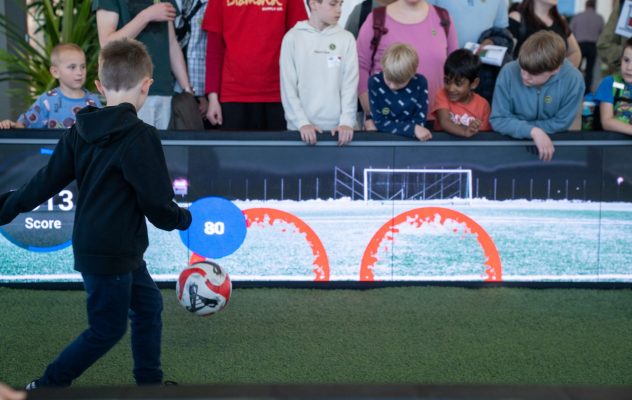
The Cube seemed to have a particular pull on younger visitors. Children of all ages stepped inside, started playing within seconds and kept coming back to try and beat their high score. What you could observe and what was also reflected in the overall atmosphere was how naturally this interaction happened.
There was no need for explanation. The system was running in “Kick-and-Play” mode: visitors entered the Cube, followed the visual guidance of the exercise and immediately started playing. Whether it was children or adults, the reaction was the same: within moments, they were fully focused, chasing the ball and trying to hit the targets before they disappeared.
This simplicity removed the typical barrier you often see at public events.
From individual interaction to shared experience
Instead of hesitating or watching from a distance, people became active immediately. And once they started, they didn’t stop at a single attempt. They tried again, compared results, challenged others and stayed in the area longer than they initially planned.
At the same time, the interaction extended beyond the individual player. Small groups formed around the Cube, creating a shared experience where playing, watching and competing blended naturally.
Competition played an important role in this dynamic. A clear objective — achieving a higher score — was enough to drive repeated participation. Visible results made it easy for others to understand what was happening and step in themselves.
What this means for events and exhibitions
For event and exhibition environments, this highlights an important shift.
Engagement is no longer driven by information alone. Visitors expect experiences that allow them to participate actively, rather than just observe. As a result, the success of a booth or installation is increasingly defined by how much interaction it creates and not just how many people pass by.
This is where interactive formats become particularly relevant for trade fairs and exhibitions. In environments where many brands compete for attention within a limited space, creating a moment of active involvement is what differentiates one booth from the next.
The “Lange Nacht der Forschung” was designed to make science tangible and accessible to a broad audience. In this context, the Cube GO showed how interactive technology can support that goal, not by explaining more, but by enabling people to experience something themselves.
For anyone planning a trade fair presence, exhibition or public activation, the underlying question is changing. It is no longer just about attracting attention. It is about creating an experience that people want to be part of.
From Observation to Participation