
Lucia Gjeltema
Head of Data Science
In a match, a player rarely has time to separate thinking from acting. A pass is not just technique, and a decision is never made without pressure, timing, context and on-ball focus.
Yet this is difficult to capture in youth academies, where specialized testing systems still separate what the game naturally combines. Being able to objectively track a player’s current level of execution in these situations gives academies a clear advantage by enabling more precise talent identification, targeted training interventions and clearer tracking of progression.
At KKS Lech Poznań, bridging this disconnect has become a central focus: capturing performance in a way that reflects the reality of the game.
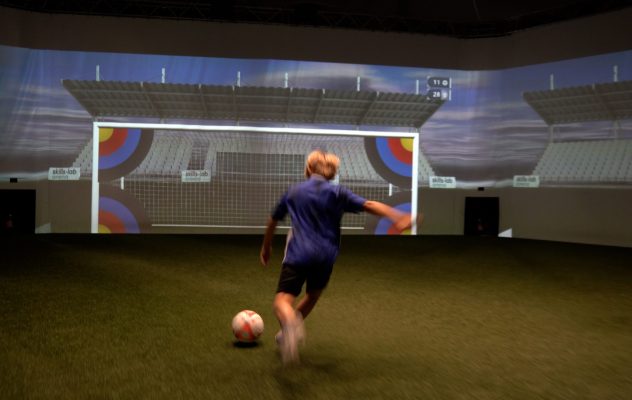
To address this, the club has integrated the skills.lab Arena into its daily workflow, not only for training, but also for structured assessment.
As part of one of the most successful professional football environments in Poland, with Lech Poznań winning the national championship for the second consecutive season in 2025/26, the club’s elite Academy continuously works on refining how game-relevant performance is developed and assessed.
One of the coaches working closely with this environment is Michał Dolata, Youth Team Coach at Lech Poznań. Alongside his coaching role and working with players in the Arena on a regular basis, he has been involved in applied research to better understand how these complex, game-relevant skills can be measured in a structured and reliable way.
Most player assessment approaches still separate these skills: observe technical skills on the pitch and measure cognitive skills in the lab. A research paper by Dolata et al (1) combines them by evaluating players in the skills.lab Arena, a football training system designed to closely resemble real match situations.
They set out to test their hypothesis: game-realistic performance in the skills.lab Arena can be measured with enough consistency to be truly useful for player development and assessment:
„In light of the results, the skills.lab Arena can be considered a reliable diagnostic tool for assessing motor-cognitive performance in young soccer players.
“
Michał Dolata et al. | Reliability and Utility of the skills.lab Arena as A Real-Time Measurement Technology for Soccer Technique and Cognitive Performance
Traditional testing has a clear limitation: it often isolates what the game naturally combines. Cognitive tests are typically conducted in controlled lab environments, whereas on-field assessments focus on physical and technical output.
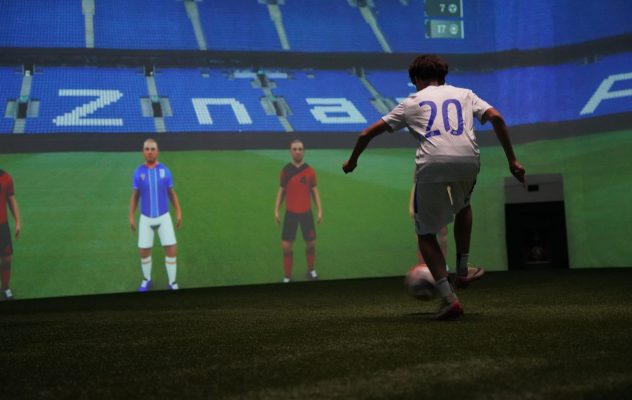
The skills.lab Arena was developed to bridge this gap. It combines technical, physical and cognitive abilities.
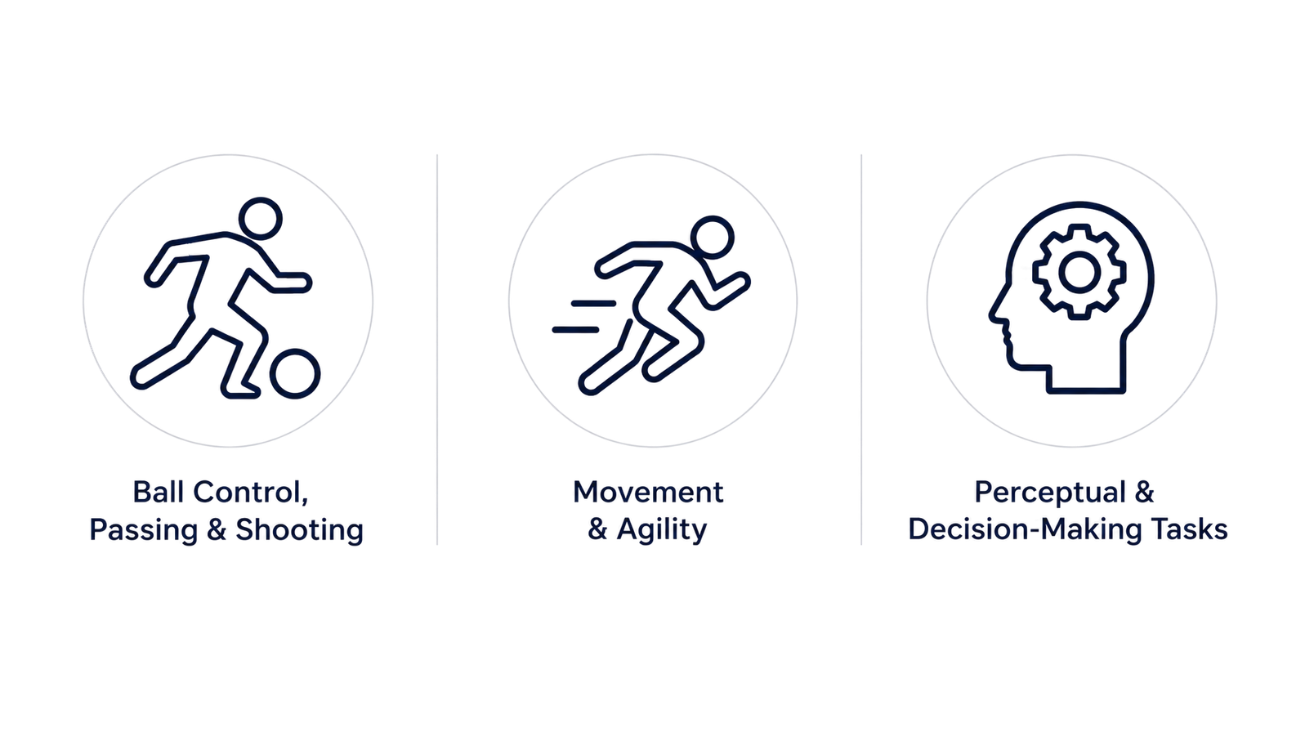
All of this happens within a dynamic, football-specific environment using ball machines, tracking systems and interactive visual stimuli. This allows players to respond to game-like situations, such as moving teammates, while executing technical actions under time pressure.
In the study, 31 youth players with ages 13-14 completed a battery of 10 different football exercises inside the Arena, designed to assess various aspects of U14 football skills. All participants had at least 3 years of competitive experience and trained 4 times per week at a football club, including weekend matches.
The tests were repeated over multiple sessions (after 7 days and after 1 month) to assess how consistent and reliable the measurements were.
One of the central questions was whether such a complex system can produce stable and repeatable results. To assess this, the researchers used established reliability metrics intra-class correlation coefficients, coefficients of variation and Bland-Altman analysis to compare results across multiple test sessions.
Reliability of a skill in isolation is expected, reliability in complexity is not. The study shows that the skills.lab Arena provides good reliability across sessions. Even though the tasks combine multiple skill dimensions, the skills.lab Arena produced consistent outputs, which is an essential requirement for any performance diagnostic tool.
For coaches, this is fundamental. It means results are stable enough to trust from one session to the next, providing a dependable baseline for evaluating players. Instead of relying on isolated observations or subjective impressions, performance can be assessed consistently, even in complex, match-contextual scenarios.
Beyond reliability, the study also looked at whether the skills.lab Arena can detect meaningful changes in performance. To do this, the researchers compared smallest worthwhile change and typical error,a standard approach to determine whether observed improvements exceed normal measurement noise.
„The analysis of the usefulness ensures that the tests in the skills.lab Arena are not only reliable but also sufficiently sensitive to detect even the smallest improvements crucial for player development.
“
Michał Dolata et al. | Reliability and Utility of the skills.lab Arena as A Real-Time Measurement Technology for Soccer Technique and Cognitive Performance
In practical terms, this lets youth coaches see where targeted interventions lead to real improvements. The authors conclude that the skills.lab Arena can distinguish real improvements from random variation and performance changes observed are practically meaningful, not just statistical noise.
Repeated testing often leads to improved results simply because players become familiar with the task, the so-called learning effect. The researchers tested for this learning effect via repeated-measures ANOVA and Bonferroni-adjusted post-hoc comparisons. Interestingly, this effect was largely absent:
Nearly all tasks showed no significant learning effect, indicating that repeated exposure to the tests did not artificially inflate performance. Only one agility task (a sprint parcours with ball) showed noticeable improvement over time, therefore a learning effect could not be ruled out.
The absence of a learning effect reinforces that the skills.lab Arena measures underlying ability rather than short-term adaptation to the test format. For coaches, this means that improvements in the skills.lab Arena are more likely to reflect actual development, not just players getting used to the drill.
„In technologically advanced environments like the skills.lab Arena, the combination of precise measurement tools and advanced data analysis enables the accurate detection of both technical skills and cognitive abilities under game-like conditions. As a result, these tests are exceptionally useful not only for talent identification, but also for the continuous development of players
“
Michał Dolata et al. | Reliability and Utility of the skills.lab Arena as A Real-Time Measurement Technology for Soccer Technique and Cognitive Performance
The results confirm that the skills.lab Arena is a reliable and sensitive measurement system. The study reflects an ongoing shift in how and why performance is assessed:
The shift is not just technological, it’s conceptual: from measuring isolated actions to measuring how players actually combine them. And once that becomes measurable, it becomes trainable.
—
(1) Michał Dolata *, Teresa Zwierko °, Łukasz Bojkowski ‡, Brandon Moran *†, Robert Śliwowski ‡
Reliability and Utility of the skills.lab Arena as A Real-Time Measurement Technology for Soccer Technique and Cognitive Performance.
Journal of Sports Science and Medicine. 2025, 24: 277-291.
https://doi.org/10.52082/jssm.2025.277
Author affiliations:
* KKS Lech Poznań
° University of Szczecin
‡ Poznań University of Physical Education
† Seattle Pacific University